- January 30, 2022
- by sekhs4414@gmail.com
- Bio-Fertilizers, Liquid Bio-Fertilizers
Zinc Solubilizing Biofertilizers (ZSB): A Natural Solution for Better Nutrient Availability and Crop Growth
Zinc is one of the most important micronutrients required for healthy plant growth and higher crop productivity. However, in many agricultural soils, zinc is present in insoluble forms that plants cannot absorb efficiently. Zinc deficiency can lead to poor crop growth, reduced yield, and lower crop quality.
To address this issue naturally and sustainably, farmers are increasingly using Zinc Solubilizing Biofertilizers (ZSB). These beneficial microbial biofertilizers help convert unavailable zinc into plant-available forms, improving nutrient uptake and supporting healthy crop development.
At Gujarat Organic Fertilizer, we are committed to providing advanced organic and biofertilizer solutions that improve soil fertility, nutrient efficiency, and sustainable agricultural productivity.
What are Zinc Solubilizing Biofertilizers (ZSB)?
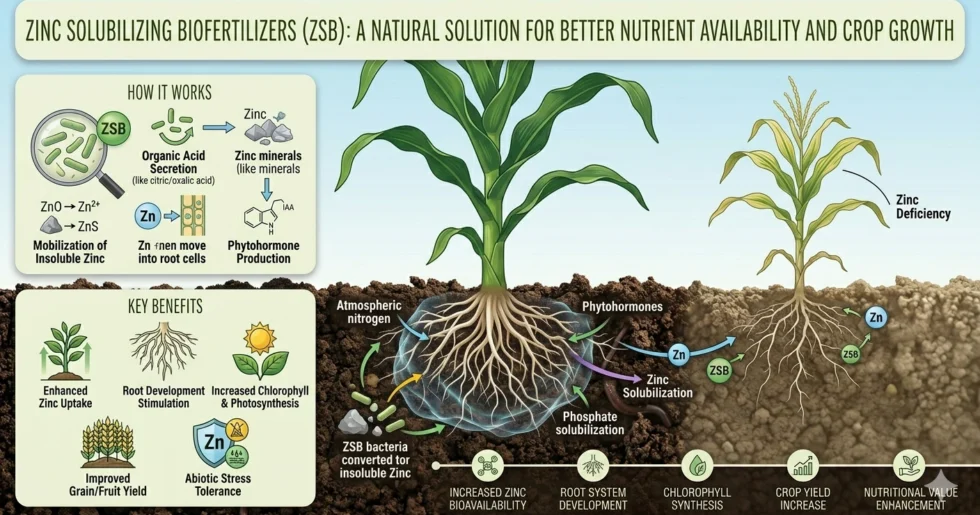
Zinc Solubilizing Biofertilizers (ZSB) are microbial formulations containing beneficial zinc-solubilizing microorganisms. These microbes help dissolve insoluble zinc compounds present in the soil and convert them into forms easily absorbed by plant roots.
The microorganisms release organic acids and natural compounds that increase zinc availability in the root zone.
ZSB improves zinc availability naturally while supporting healthy soil microbial activity.
ZSB acts as an eco-friendly alternative to excessive chemical zinc fertilizers and supports balanced crop nutrition.
Importance of Zinc in Agriculture
Zinc is an essential micronutrient required for several important plant functions.
Functions of Zinc in Plants:
- Promotes enzyme activity
- Supports chlorophyll formation
- Improves root development
- Enhances flowering and fruiting
- Helps protein synthesis
- Supports plant growth hormones
- Improves crop quality and yield
Zinc deficiency in crops may cause:
- Yellowing between leaf veins
- Stunted plant growth
- Poor root development
- Delayed maturity
- Reduced crop yield
Zinc is essential for healthy plant metabolism and balanced crop growth.
How ZSB Works
Zinc Solubilizing Biofertilizers work through beneficial microorganisms that:
- Solubilize insoluble zinc compounds
- Release organic acids
- Improve zinc availability near roots
- Enhance nutrient absorption efficiency
- Support healthy microbial activity in soil
These biological activities help crops absorb zinc more efficiently from the soil.
Benefits of Zinc Solubilizing Biofertilizers (ZSB)
1. Improves Zinc Availability
ZSB converts unavailable zinc into plant-available forms naturally.
2. Enhances Crop Growth
Adequate zinc nutrition improves plant growth, vigor, and crop development.
3. Improves Root Development
Better zinc availability supports stronger and healthier root systems.
4. Increases Crop Yield and Quality
Balanced micronutrient nutrition improves productivity and crop quality.
5. Enhances Nutrient Uptake
Healthy root systems absorb nutrients and water more efficiently.
6. Improves Soil Microbial Activity
Beneficial microorganisms improve soil biological health and nutrient cycling.
7. Reduces Chemical Fertilizer Dependency
ZSB helps reduce excessive use of chemical zinc fertilizers.
8. Eco-Friendly and Sustainable
ZSB supports environmentally safe and sustainable agricultural practices.
ZSB improves both micronutrient efficiency and long-term soil fertility naturally.
Crops Suitable for ZSB
Zinc Solubilizing Biofertilizers can be used for various crops, including:
- Wheat
- Rice
- Maize
- Cotton
- Sugarcane
- Groundnut
- Pulses
- Oilseeds
- Vegetables
- Fruits
- Flowers
- Horticulture crops
- Plantation crops
ZSB is suitable for both conventional and organic farming systems.
Methods of Application
1. Seed Treatment
Seeds can be treated with ZSB before sowing to improve early nutrient availability.
2. Soil Application
ZSB can be mixed with compost or organic manure and applied to the soil.
3. Root Dipping
Seedlings may be dipped in ZSB solution before transplantation.
4. Drip Irrigation / Fertigation
Liquid ZSB formulations can be applied through irrigation systems.
Proper application methods help maximize nutrient efficiency and microbial activity.
ZSB vs Chemical Zinc Fertilizers
| Feature | ZSB | Chemical Zinc Fertilizers |
|---|---|---|
| Nutrient Source | Biological solubilization | Synthetic zinc supply |
| Soil Health | Improves microbial activity | Excess use may affect soil health |
| Environmental Impact | Eco-friendly | Higher chemical load |
| Nutrient Efficiency | Better long-term availability | Short-term supply |
| Sustainability | Excellent | Limited |
| Cost Efficiency | Reduces fertilizer dependency | Higher input cost |
Role of ZSB in Sustainable Agriculture
Modern farming requires balanced nutrient management and environmentally responsible agricultural practices.
ZSB is an important biofertilizer for sustainable and regenerative agriculture.
It helps farmers:
- Improve micronutrient availability naturally
- Reduce chemical fertilizer dependency
- Improve soil biological activity
- Increase crop productivity and quality
- Support eco-friendly farming systems
Biofertilizers like ZSB are becoming increasingly important in integrated nutrient management and organic farming.
Gujarat Organic Fertilizer – Supporting Sustainable Farming Naturally
At Gujarat Organic Fertilizer, we provide premium-quality biofertilizers and organic agricultural solutions designed to improve crop productivity and soil health naturally.
Our focus is on:
- Sustainable farming practices
- Better nutrient management
- Soil fertility improvement
- Eco-friendly agricultural solutions
- Long-term crop productivity
We are committed to helping farmers build healthier soil and achieve better harvests naturally.
Conclusion
Zinc Solubilizing Biofertilizers (ZSB) are an effective and eco-friendly solution for improving zinc availability in agricultural soils. By naturally converting insoluble zinc into plant-available forms, ZSB enhances crop growth, root development, nutrient efficiency, and overall productivity.
As agriculture moves toward sustainable and environmentally safe practices, ZSB is becoming an essential component of modern nutrient management.
For trusted biofertilizer and organic farming solutions, choose Gujarat Organic Fertilizer.
Frequently Asked Questions (FAQs)
What is ZSB in agriculture?
ZSB stands for Zinc Solubilizing Biofertilizers, which help make soil zinc available to plants naturally.

What are the benefits of ZSB?
ZSB improves zinc availability, crop growth, root development, soil fertility, and crop productivity.
Can ZSB reduce chemical fertilizer usage?
Yes, ZSB helps reduce dependency on chemical zinc fertilizers.
Which crops can benefit from ZSB?
Wheat, rice, maize, cotton, sugarcane, vegetables, fruits, and horticulture crops can benefit from ZSB.
Is ZSB suitable for organic farming?
Yes, ZSB is widely used in organic and sustainable farming systems.